
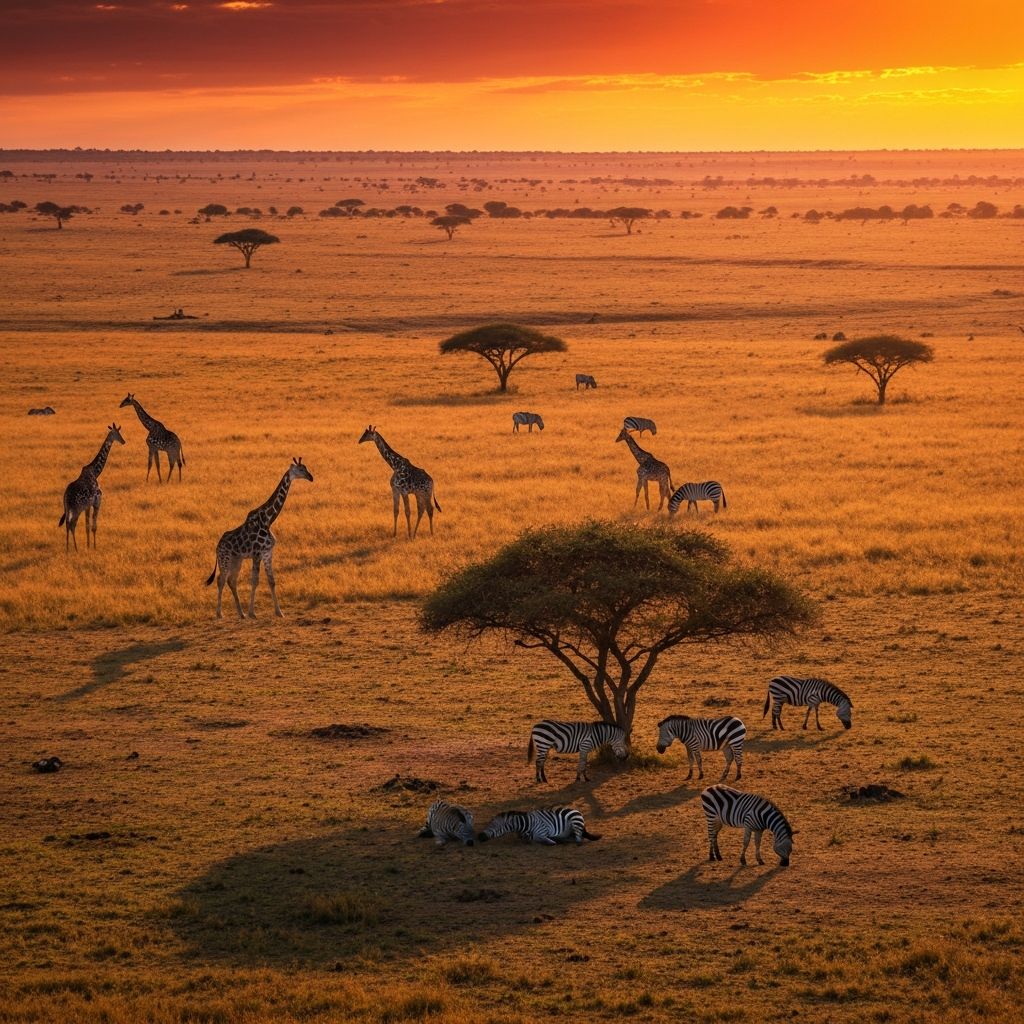
The Great Migration isn’t a single event — it’s a year-round circuit of roughly 1.5 million wildebeest, 250,000 zebra, and 500,000 gazelle following the rains across a 30,000 km² ecosystem. They follow a clockwise loop: south across the Serengeti during the calving season, north through the western corridor, then across the Mara River into Kenya, and back south as the rains move.
The month-by-month loop
January – March: Calving season, southern Serengeti
The herds gather on the short-grass plains of the southern Serengeti and Ndutu, where roughly 8,000 wildebeest are born every day in a three-week window in February. It’s a predator’s paradise — lions, cheetahs, and hyenas concentrate here, and you’ll see hunts almost every game drive.
April – May: Long rains, central Serengeti
The rains begin and the herds drift north-west through the Seronera area. This is the cheapest time to visit, with rates dropping 30–40%. You’ll trade some daily sightings for green landscapes and flowering grasslands — and often, crowds disappear.
June – July: Western corridor & first river crossings
The herds reach the Grumeti River in the western Serengeti. Crossings here are smaller than the famous Mara crossings but still feature crocodile ambushes. By late July the leading edge of the migration is approaching the Kenya border.
August – October: Masai Mara & Mara River crossings
This is the headline event. The herds pour across the Mara River into Kenya, where they face the most dangerous crossings of the year — currents, crocodiles, and steep banks. Crossings happen daily but unpredictably; you may wait three hours at a crossing point for nothing, or you may see five in a single afternoon.
Best tip: book at least 5 nights in the Mara during this window so you get multiple chances. Stay in a camp inside or right next to the reserve — the further you have to drive in, the less time you spend at crossing points.
November – December: Short rains, return south
Light rains drive the herds south again, back through the eastern Serengeti towards the calving plains. November is a beautiful, quiet month — green landscapes, baby animals starting to appear by late December, and lower rates than the August–October peak.
Where to base yourself
- Serengeti calving (Jan–Mar): Ndutu, southern Serengeti mobile camps.
- Western corridor (Jun–Jul): Grumeti area lodges.
- Mara crossings (Aug–Oct): Mara Triangle camps, north Serengeti tented camps if you want both sides of the border.
- Return south (Nov–Dec): Central or eastern Serengeti.
How long do I need?
Minimum 4 nights in the migration zone to give yourself realistic odds of seeing a crossing during peak season. We strongly recommend 5–6 nights, ideally split across two camps to cover more ground.
Migration vs. resident game
Don’t book a migration safari if you’re after the Big Five — book a Big-Five safari that happens to overlap with the migration. The Mara, Serengeti, and Ngorongoro all have spectacular resident populations of lions, leopards, elephants, and buffalo regardless of where the herds are. The migration is the headline; the supporting cast is what most people remember.